Табор уходит в небо
A lush, romantic, tragic musical‑drama about freedom, passion, and fatal love.
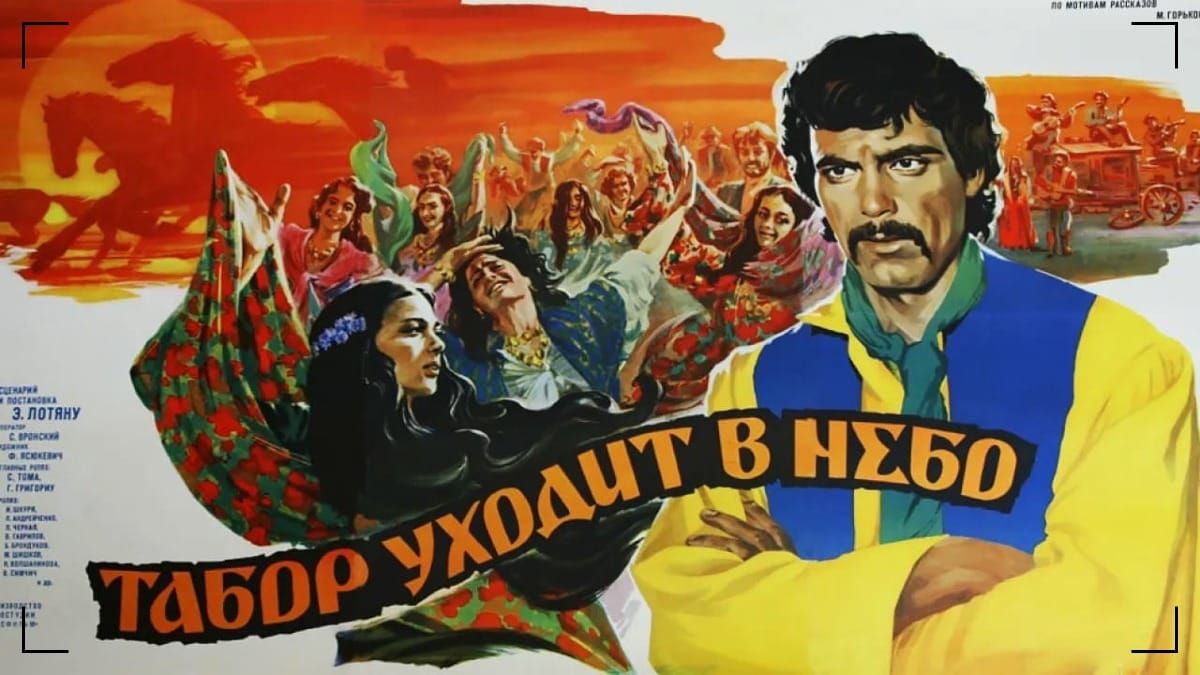
Identity of the Film
Табор уходит в небо (Gypsies Are Found Near Heaven, 1975/1976), also called Queen of the Gypsies is a Soviet romantic musical‑drama directed by Emil Loteanu, produced by Mosfilm, and based on Maxim Gorky’s early stories Макар Чудра (1892) and Старуха Изергиль (1894). It became the most attended film in the USSR in 1976, selling 64.9 million tickets
The film stars Svetlana Toma (Rada) and Grigore Grigoriu (Loiko Zobar), whose performances became cultural landmarks. It was filmed partly in Moldova and incorporates musical sequences in Romany, such as Loli Phabay, emphasizing themes of passion, freedom, jealousy, and fatal pride characteristic of Roma folklore.
Setting & atmosphere
The story unfolds in the early 20th century, in a Roma camp on the Tisza River in the Zakarpattia region, then part of the Austro‑Hungarian Empire. The film is known for its:
- sweeping landscapes
- vibrant Roma culture
- expressive music and dance
- poetic, folkloric tone
It’s visually rich, almost operatic - Loteanu’s signature style.
They’re dug up from the bone yard, pieced together in the dark when the rest of the world is asleep. They cost something to tell.
If you want to keep the lights on in this place, if these words are worth more to you than a cheap cup of coffee, then step up. Don’t just be a ghost passing through. Become a member. Keep the ink flowing.
THEMATIC ANALYSIS
Freedom as the Central Moral Currency
Freedom is the film’s gravitational center: Personal, emotional, tribal, existential.
Rada embodies a radical, almost mythic autonomy. She refuses to belong to any man, noble or Roma. Her independence is not framed as rebellion but as identity: a non-negotiable condition of her existence. This portrayal aligns with Gorky’s original depiction of Rada as a woman whose pride and autonomy are inseparable from her dignity and survival.
Loiko Zobar is a horse thief, a wanderer, a man whose pride is indistinguishable from his liberty. His love for Rada is genuine, but it collides with his own code of honor: a code that demands he never kneel, never submit, never be owned.
The tragedy arises because both characters value freedom over life, yet each desires a love that demands surrender.
This is the film’s core paradox: Love requires vulnerability; pride forbids it.
This tension is inherited directly from Gorky’s Makar Chudra, where the incompatibility between love and absolute freedom leads to mutual destruction.
Fatalism: The Story as a Pre‑Written Destiny
The film is steeped in fatalism, visually and narratively.
Gorky’s fatalistic roots
In Makar Chudra, the story is told by an old wanderer who recounts the doomed love of Loiko and Rada as a cautionary legend — a tale in which fate is inevitable, and pride is a curse. Loteanu preserves this tone: the lovers are not victims of circumstance but of their own unyielding nature.
Signs of fatalism in the film
- The recurring motif of the wandering camp, always moving, never settling.
- The white mare, a symbol of purity and sacrifice.
- The riverbank scene, a moment of peace that feels like a prelude to loss.
- The constant presence of soldiers, law, and death reminds us that freedom has a price.
The ending
The tragic culmination underscores the idea that freedom and love cannot coexist for these characters. Their deaths feel less like events and more like the fulfillment of a prophecy, a destiny sealed long before they met.
Gender Roles: Pride, Power, and the Refusal of Submission
The film’s gender dynamics are complex, rooted in Gorky’s romanticized but harsh portrayal of Roma codes of honor.
Rada: autonomy as defiance
Rada is not submissive, not passive, not a romantic ideal. She is:
- proud
- self‑possessed
- emotionally disciplined
- unwilling to be bought, owned, or pitied
Her rejection of the nobleman Antol Siladi - publicly, humiliatingly - reinforces her refusal to be commodified or controlled.
Loiko: masculinity as honor
Loiko’s masculinity is defined by:
- courage
- pride
- mastery of horses
- refusal to kneel
His love for Rada is sincere, but it is filtered through a code that demands dominance and recognition. This is where the tragedy ignites:
- Rada wants love without ownership.
- Loiko wants love that acknowledges his honor.
The clash
Their relationship becomes a duel of wills, not between man and woman, but between two equally proud individuals whose identities cannot bend without breaking.
Production Background
Literary Sources
The film draws heavily from:
- “Makar Chudra” (1892) - the core plot of Loiko and Rada’s doomed love.
- “Old Izergil” (1894) - mythic motifs of defiance, sacrifice, and the cost of freedom, including the legends of Larra and Danko.
Loteanu blends these sources into a single narrative that feels folkloric, operatic, and timeless.
Visual & Musical Style
- Shot in Moldova with sweeping landscapes and choreographed camp life.
- Music by Eugen Doga, whose compositions became iconic.
- Use of Romany musical sequences to emphasize authenticity and emotional intensity.
Casting & Performances
Svetlana Toma’s portrayal of Rada earned her recognition as one of the most celebrated Soviet actresses of the year. The remaining cast is here.
CULTURAL IMPACT
A Soviet Blockbuster
With over 64 million tickets sold, it became the most-watched film in the USSR in 1976.
Iconic Representation of Roma Culture
The film shaped Soviet popular imagination about Roma life — romanticized, musical, passionate, free. While stylized, it became a cultural touchstone for depictions of Roma identity in Eastern Europe.
Aesthetic Legacy
- Doga’s music remains widely performed.
- Rada and Loiko became archetypes of tragic lovers.
- The film influenced later portrayals of nomadic life, fatalistic romance, and folkloric storytelling.
International Recognition
The film was screened internationally (in Toronto and the U.S.) and helped establish its status as one of Mosfilm’s most recognizable works abroad.
Why This Analysis?
Because some stories don’t stay buried, no matter how deep I shove them into the dark. They wait. They linger like old cigarette smoke in a closed room, clinging to the curtains, the furniture, the parts of me I thought I’d outgrown. And then one day, without warning, they come back: sharp, alive, demanding to be acknowledged.
For me, it started with a movie.
I remember watching Табор уходит в небо in the safety of my great‑grandparents’ place: back when Yugoslavia was still one country, and I was still small enough to believe adults knew what they were doing. The place smelled of old memories, dust, and the kind of history that seeps into your bones whether you want it to or not.
I was a child torn between two worlds. My mother tried to build me a safe haven in Nicosia. My father, somewhere in Germany or Norway, waking up after eight years' absence, was pushed by my great‑grandfather Avram - a man whose word carried the weight of an entire lineage - to finally take responsibility for me.
And somewhere in that chaos, a private detective was hired to track me down. A child being hunted across borders, not because he was lost, but because the adults were.
That’s the kind of beginning that shapes a life in ways you don’t understand until much later.
And then there was the movie.
A storm of passion, fire, and fatal love. A world where freedom was a curse and desire was a blade. And in the middle of it all - Loli Phabay - that song that didn’t just play, it cut. It carved itself into me with a precision I couldn’t explain. I didn’t have the words for it then, but something in that music, in those characters, in that raw, unfiltered emotion, branded me.
Then life swept me forward. New countries. New languages. New versions of myself. And the memory sank, not gone, just submerged, like a wreck resting quietly on the ocean floor.
Years passed. Decades. Enough time to forget what I thought I’d never remember.
And then one day, by pure accident, the kind of accident that feels like fate wearing a crooked grin, I stumbled onto a video of Loli Phabay.
The first notes hit me like a punch to the ribs. And suddenly the past didn’t whisper. It roared.
Belgrade. Cyprus. The detective. The tug‑of‑war. The fear. The longing. The child who learned to survive by staying quiet.
All of it came rushing back in a single, merciless wave, a tsunami of memory and emotion I didn’t know I still carried.
That’s why this analysis exists. Because some stories don’t fade. They wait for the right moment to return. And because I want you to feel the importance of this movie.