Plotter Notebook System Intended Use
Lochby vs Filofax vs Roterfaden vs Ro-Biki vs Midori TN
The room and your fingers are black with old dust. You're sorting a box of negatives. Some frames are sharp, most are noise, a few are the ones you can't lose.
That's the mood the Japanese Plotter notebook system is built for: Catching ideas fast before they fade, then deciding what's worth carrying into the light.
So, what can you do with Plotter that you can't with a Filofax? Good question. Nothing. They both work the same way. Hold that thought.
Its intended use is plain: you capture quick notes, you refine them by moving pages and grouping them, then you archive what matters and toss the rest. It can act like a planner, sure, because it takes schedule refills, but that isn't the main point. The real promise is control over your paper, page by page, without hauling a swollen notebook full of dead weight.
In this post, you'll get a quick, practical breakdown of how Plotter is meant to work and where it fits alongside other systems. Filofax sits in the same ring-binder family (more classic organizer energy), Lochby and Roterfaden lean modular and cover-driven (more "carry multiple books" than "re-order loose sheets"), Ro-Biki feels like a rugged bound book for linear notes, and Midori Traveler's Notebook stays slim and travel-hungry. If you already run a digital archive mindset, you'll recognize the same pressure and relief as a good filing habit, like the one in https://www.yonkeydonkey.blog/the-memex-method/.
How to use the Plotter system?
The intended use of the plotter notebook system
Capture, refine, and regularly clear out your notes
You do not buy a Plotter to keep everything. You buy it to Pen-and-ink before they vanish. The plotter notebook system is built around a simple loop: capture fast, keep the best close, then clear the rest so you can breathe.
Think like a darkroom tech with a timer in your head. You shoot. You contact print. You mark the keepers. Then you file them, or you toss them. Plotter pushes that habit onto paper, with rings that let you reshuffle evidence and stop pretending every scrap deserves a permanent home. If you want the philosophy straight from the stationery side, see a deep breakdown of Plotter's intended workflow.
Use it like a creative inbox for ideas you do not want to lose
A "creative inbox" is just a place where unfinished thoughts can land without judgment. You drop the note in, then you decide later if it becomes a project, a reference, or trash. Plotter shines here because each page can move. Nothing is trapped in the order you wrote it.
For a writer, that looks like this:
- Story seeds you catch on the street, one scene, one line of dialogue, one motive you cannot explain yet.
- Article outlines that start as a messy spine, then get rearranged into sections when the shape appears.
- Quotes and fragments you want to reuse, tagged with a source and a date before they rot.
- Character notes that grow sideways, voice, habits, and a lie they tell too easily.
- Reading lists that you review, prune, and keep tight, because infinite lists are just procrastination with good posture.
For fountain pen users, the "inbox" gets ink on it fast:
- Pen-and-ink test pages (line width, dry time, feathering, show-through), kept only until you trust the combo.
- Nib tuning notes and quick comparisons, because memory lies and paper tells the truth.
- Paper experiments ripped from a pad, punched, and filed where you can find them again.
Plotter's refill pads make this feel natural. You can write in a bound pad like a normal notebook, then tear out the one page worth saving and clip it into the binder. Meanwhile, Lochby and Roterfaden tend to hold whole notebooks, so the "inbox" becomes bulkier unless you rewrite or scan. Filofax can play inbox too, but it often pulls you toward planner structure first. Ro-Biki and Midori Traveler's Notebook (TN) keep you moving in a straight line, which is great for journaling, but not great for sorting raw fragments.
If your endgame is digital, treat the Plotter page like an intake form. Scan it, name it, and file it with the same calm you use for photos. When you want a simple naming pattern that stays searchable, keep consistent file naming for scans close.
Your Plotter is not the archive. It is the tray beside the enlarger, where the good frames wait.
The slim binder is supposed to limit you, so your projects do not sprawl
Those small rings are not a flaw. They are a bouncer at the door. Plotter's slim capacity forces a question you usually dodge: what are you actually using?
If you have ever carried a fat notebook packed with old meeting notes, you know the feeling. Dead weight. Old decisions. Pages you will never reread, but still fear throwing away. Plotter is designed to make hoarding uncomfortable. You cannot keep shoving paper in forever, so you start curating. Your active binder stays lean, and your head clears as a result.
Here's the practical win when you juggle work, writing, and life in the same week:
- You keep current projects in the binder.
- You move inactive pages out to an archive binder or storage system.
- You trash what does not earn rent.
Use a blunt rule of thumb, the kind that holds up at 2 AM:
This is where Plotter feels closer to a photo workflow than a "planner." It is ingest, edit, and archive. Lochby, Roterfaden, and Midori TN excel when you want separate notebooks for separate lanes, so your travel journal stays separate from your work log. That is clean, but it does not solve sprawl inside a project, because the pages stay bound. Ro-Biki is even more linear, tough cover, consistent paper, and a stubborn refusal to reorganize your past.
Filofax can hold a lot more, depending on rings, which sounds helpful until you realize "a lot more" becomes "everything," and then you are right back in the box of negatives, squinting at noise. Remember I asked you to hold that thought? This right here is the difference: Focus and personal preference.
Plotter's constraint is the point. You review, you pull the keepers forward, and you move the rest into long-term storage. The binder stays light enough to carry, and sharp enough to think with. The holes are compatible with Filofaxes of the same size.
How Plotter is designed to support that purpose: Paper, binder, refills, and archiving
Many notebook systems promise freedom, but they quietly trap you in the order you wrote things down. The plotter notebook system doesn't. It treats paper like negatives on a light table. You shoot fast, you pick the frames, you file the keepers, you ditch the rest.
That mindset shows up in every part of the build: a DP paper that stays consistent when you're moving quickly, a slim six-ring binder that refuses to become a junk drawer, refills meant to be torn and moved, and an archiving habit baked in. If you want Plotter's own take on how it fits planning, journaling, and notes, start with how Plotter frames system use cases.
Bound pads plus removable pages mean you can write first and organize later
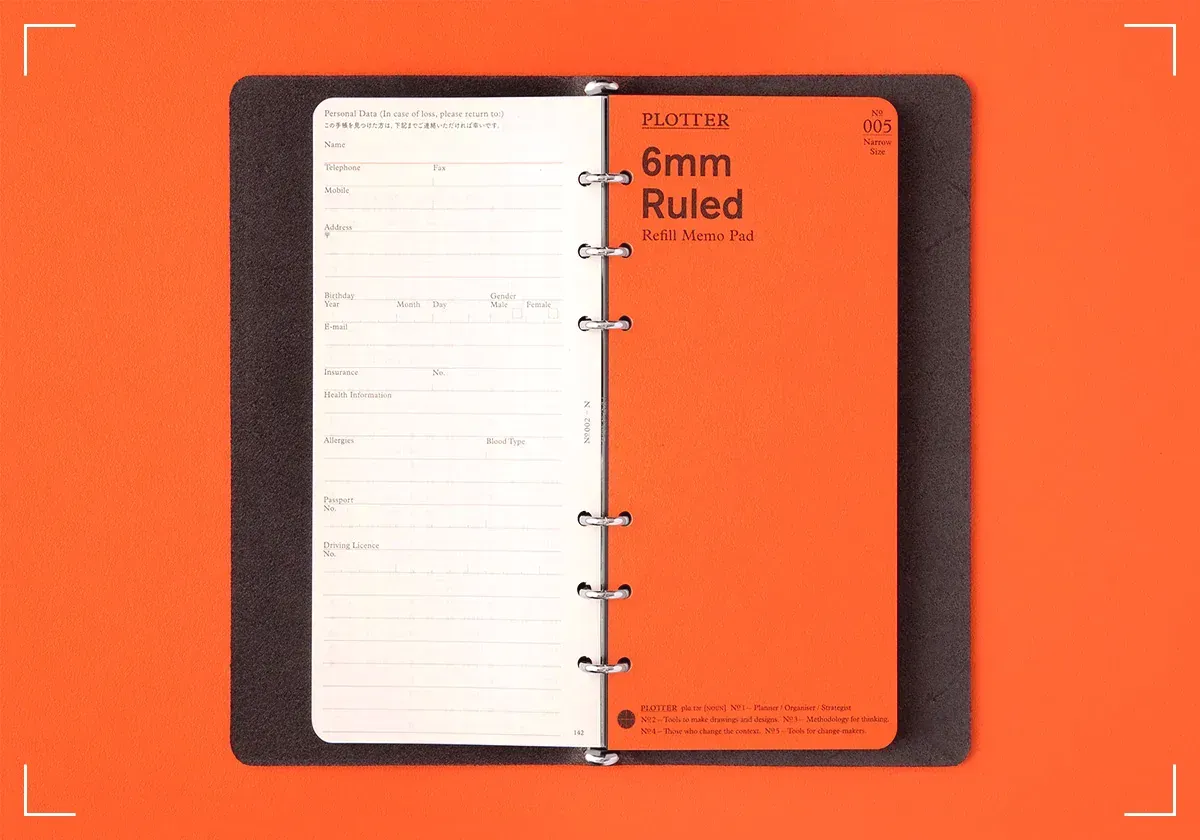
When you're out in the street with a thought you can't lose, you don't want to "set up a system." You want to write. Plotter's bound refill pads are built for that. They feel like a normal notebook in the moment, then turn into loose pages when you decide a line is worth keeping.
The intended flow is simple, and it stays honest:
- You write in a bound refill pad like you always have.
- Later, you tear out the page that still matters.
- Then you punch it into the binder, behind the right divider, where it can't vanish.
That split keeps the friction low when your brain is hot. You're not flipping rings open mid-idea. You're not deciding categories while the thought bleeds out. You're just writing, then curating later, like editing a contact sheet after the shoot.
Plotter's six-ring leather binders are intentionally plain, almost severe. Slim rings, clean spine hardware, nothing to distract you. That "thinness" is the point. It forces choices. It keeps you carrying only what you're actively working on, not the whole history of your last six months.
And the paper matters more than people admit. Plotter's DP paper has a reputation for being fountain-pen friendly, with a thin feel that still holds up under fast writing. The practical win is predictable behavior. Less bleed-through panic, fewer surprises, fewer moments where your nib catches and your thought stutters.
Here's where the comparison gets sharp:
- Filofax can do the same loose-page trick, but it often steers you toward planner structure first. Plotter tends to feel more like a creative inbox with rings.
- Lochby and Roterfaden are great for carrying whole notebooks. Still, if you need to reorganize page by page, you either rewrite, rip it up, or live with the mess.
- Ro-Biki and Midori Traveler's Notebook (TN) shine for linear logs and travel journaling. They keep time in a straight line. Plotter breaks the line on purpose.
Archiving is not optional; it is part of the system
Plotter assumes you will outgrow your daily-carry binder. Not because you failed, but because that's the job. The binder is meant to stay lean, like a camera bag that only carries what you'll actually use that day.
So archiving is not a bonus feature. It's the exit door. Once pages go cold, you move them out. Plotter even sells archive options, but the broader lesson is: keep an archive binder or storage method ready, because your main binder should stay thin enough to think with.
A simple routine keeps you from drowning:
- Monthly review: set a timer, flip through everything.
- Pull pages by project: active stays, inactive leaves.
- Label and store: a date, a project name, and one line of context.
- Recycle the rest: dead notes go in the bin, no ceremony.
That last step is where most people hesitate. You keep scraps because you're scared you'll need them. Plotter's design pokes that fear with a stick. If it isn't earning space in your binder, it goes to the archive or away.
This is also where cost control becomes real. Plotter's ring spacing is not some locked vault. In practice, you can punch your own sheets with a Filofax puncher and mix in compatible refills from other six-ring systems. That means:
- You can run Plotter as the premium binder, but feed it paper you already trust.
- You can test layouts Filofax-size compatible inserts before buying more Plotter refills.
- You can build project templates on your printer, punch them, and keep moving.
In other words, Plotter gives you the same discipline you use in digital asset management. Ingest, edit, archive, then cold storage. The binder is your working set. The archive is your long tail. Everything else is noise you no longer have to carry.
Plotter vs other notebook systems, which one matches the way you think and write?
Picture your notes like negatives drying on a line. Some frames are sharp, some are trash, most are "maybe." The system you choose decides what happens next: whether you can reshuffle the whole contact sheet or stay stuck with the order you shot it in.
The plotter notebook system is at its best when you treat paper like a working set. You carry only what's alive, you move pages like you mean it, and you push yesterday into cold storage before it starts to stink. Other notebook systems can still get you there, but they do it with different friction, different weight, and different assumptions about how you think.
If you want movable pages, compare Plotter with Filofax, not Roterfaden or Ro-Biki
When you want pages that move, you're admitting something honest. You don't think in order. You think in bursts, rewrites, and re-sorts, the same way you edit a shoot after the fact.
Plotter: The plotter notebook system stays slim on purpose, with small rings that force you to curate. You capture fast, then you refine by pulling the best pages forward and dropping the rest. It's a focused everyday carry that keeps your active projects close and your clutter far away.
Filofax: Filofax comes from a planner-first tradition, so it often nudges you toward calendar structure and lots of inserts. You usually get more capacity, more pockets, and more "organizer" features, but the setup can turn bulky fast. Filofax's paper quality and refills aren't fountain pen friendly, so that's that.
Roterfaden: Roterfaden feels like an heirloom tool, thick, rugged, and built for long-term carry. It shines when you want a substantial organizer that takes abuse and still looks better with scars. The trade-off is weight and volume, because it can start to feel like carrying a small file cabinet.
Ro-Biki: Ro-Biki sits closer to the compact Japanese notebook vibe, especially if you like the size and portability but want a different ecosystem or slimmer notebooks. It's a practical choice if you like Traveller's Notebooks, but need something narrower. And the Ro-Biki cover comes with pockets and room for your pens. Still, it doesn't give you the same loose-leaf reordering power, so your "edit" happens more in your head than on the page.
To keep the choice clean, think in workflow terms, as you would with photo management:
- Ingest: Where do raw notes land when you're tired and in a hurry?
- Edit: Can you reorder the keepers without rewriting them?
- Archive: How quickly can you move dead pages out of your daily carry?
If you want a deeper look at mixing systems in real life (and why many people keep a hybrid analog stack), the examples in a multi-system notebook rotation write-up are worth your time.
If you want multiple thin notebooks, compare Plotter with Midori Traveler's Notebook, Ro-Biki, and Lochby
Some days you do not want movable pages. You want separation. One slim book for the road journal, one for work notes, one for sketches, one for the lines you write when you can't sleep. That's not weakness, it's a boundary.
Midori Traveler's Notebook (TN) is built around elastic inserts. You can swap in thin booklets and keep different modes in different volumes, which feels natural for travel journaling and long trips. The catch is simple: you can't reshuffle pages with the same ease as looseleaf, so "refine" usually means rewriting, flagging, or scanning later. Or a linear mind.
Ro-Biki is Midori TN's younger brother. It's more fashionable in how it dresses its notebooks. The idea is the same as with TN. The cover is soft, has room for pens, and a zipped pocket for small stuff. The page size is as large (A5) and a bit narrower than TN. The difference is maybe what you're looking for.
Lochby often feels like a notebook-wallet hybrid, the kind of carry that keeps quick notes, cards, and small tools close at hand. It's great when you need more storage, and you don't want to baby the gear. However, it's not centered on page-by-page reorganization, so it behaves more like a portable desk than an editing bench. And it looks like it joined the Foreign Legion before becoming a notebook cover.
This is where intent matters, because the systems solve different problems:
- Plotter is for rearranging and refining pages. You write first, then you sort, then you keep only what earns space. You've a serial mind.
- Traveler's Notebook and Ro-Biki are for swapping inserts. You separate your life into booklets and move between them as needed.
- Lochby is for quick capture and carry. You keep tools and notes together, then decide later what becomes "real."
A simple analogy helps. Plotter is your light table. TN or Ro-Biki is your stack of labeled film canisters. Lochby is your jacket pocket with a memo pad and a pen that always works.
So ask yourself this: do you need to edit your notes, or just store them? When your writing is project-driven, with outlines, drafts, and reshuffled arguments, the Plotter notebook system aligns with how you think. When your writing is time-driven, a logbook of days and miles, TN, Ro-Biki, Lochby, or even Filofax may feel like the truer witness.
Conclusion & checklisty
For paid members only.